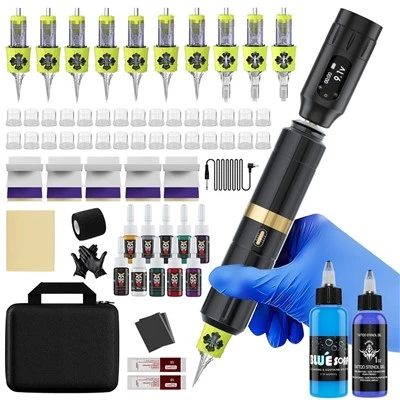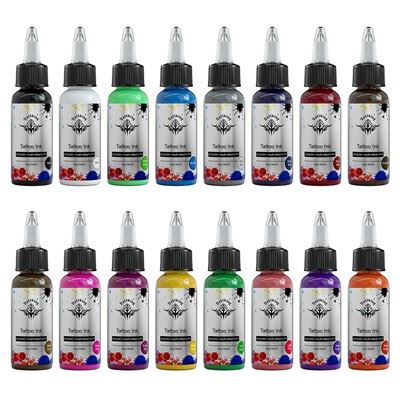
In the tattoo industry, the terms "powder pigment" and "water-based pigment" are very common. In fact, these two terms are very inaccurate. The pigments that we can buy on the market are basically "water-soluble". Yes, they are all mixed with pure water and some organic solvents. The difference is mainly in three points. One is the particle size of the pigment itself, and the second is the proportion of the toner in the entire bottle of color. The third point is the proportion of "white powder" in the colorant.
Let me talk about the concept of pigment particles. Nowadays, the pigments of various chemical products we use (don’t believe in any natural nonsense, many natural pigments are highly toxic) are composed of two parts, one part is toner, One part is the blending agent, including oil paints, paints, watercolor paints and tattoo pigments, all of which are the same concept. Since it is a toner, the size of the toner particles is also different according to the requirements and the difference in processing accuracy. Among the commonly used pigments, the particles of general color toners are larger than black, and the size of the particles of different pigments will have different characteristics in use.
Large particle colorant
It is not easy to bleed, because the color pigment particles are relatively large, it is not easy to have too much displacement in the body, and it is not easy to cause bleed due to displacement.
It is suitable for covering. When I was a child, I heard an inspirational story about a basket of apples. No matter how you hide the big apples underneath, after bumps, the big apples will always be topped to the top. This is a metaphor for good people. Able to get ahead. I don’t know if I can get ahead, but the principle of this phenomenon was mentioned in junior high school physics. Large molecules will go up and small molecules will sink down (the heating cycle also uses this principle). When covering, If you use large particles of colorant to cover the small particles of colorant, it will be much easier, because after the colorant is mixed in the body, the large particle of colorant will eventually move to the upper layer to cover the small particle of colorant underneath.
It is not easy to paint. Our needles have the same size of the opening in the skin under the premise of the same thickness. Large particles of coloring material are relatively less easy to pour into the wound. (The solution is to use a thicker needle, which will be discussed later)
It is not easy to metabolize. The metabolism of colorants is inevitable in the body. Large particles of colorants are not easy to be swallowed by white blood cells because of their large size, so the metabolic cycle will be much longer.
Small particle color
It is easy to enter the color, because the particles are relatively small, under the premise of the same thickness of needles, it is easier to fill the wound than the large particles of color, and the color is easier to enter.
Easy to make gradation, because the particles are small, it is easy to mix with other colors, and it is easier to make subtle color transitions.
It is easy to faint, because the pigment particles are small and easily free from the original position in the later stage of recovery, and it is relatively easy to faint, but this is a good thing for large areas of uniform color or color gradation.
It is easy to pigmentation, because the particles are small, it is easy to go down in the skin, so it is more affected by the skin color, but this will look more "old" when doing the old traditional style.
It is easily metabolized, and small particles are easily dried out by white blood cells, so the discoloration will be more obvious after a long time.
Let's talk about the toner particles, let's talk about the toner ratio.
The ratio of toner is generally complementary to the particle size of the pigment. Generally speaking, there are three common ratios: high ratio of large particles, low ratio of small particles, and high ratio of small particles.
For example,large-particle high-proportion pigments, the most typical one is Eterno. Most of Eterno’s pigments have a high toner ratio, so high that there is almost no excess water precipitation (no layering) in the pigments. The color material is very viscous, which can make the color airtight. It is especially suitable for heavy color, new school or as a cover, but there is a troublesome disadvantage in use, that is, it is too viscous and it is very difficult to wipe clean.
Small-particle low-proportion pigments are common "water-based" pigments, such as Orpheus. Such pigments are relatively thinner and have the advantage of good coloring. And because of the thinness, the effect of multiple overlapping colors will be certain. Therefore, it is very suitable for the edge color of color realistic or watercolor style.
Small particles and high proportion of pigments. The most common one is the totem black we commonly use. In fact, we use various gradation blacks. For the same brand, the pigment particles are the same, but the proportion is different from the additive blend. Totem black is a high proportion of pigment (black toner has small particles). The advantage of this pigment is that it can make an extremely dense black, but the disadvantage is that the purity is too high. If you use totem black to cut thin lines For a long time, it will almost inevitably faint, so remember not to use totem black to make English words, even if you use it, you need to add a drop or two of water, and because the particles are small and dense, it is easy to have slight skin after coloring. Protrusions, this is not because of skin lesions, but because too many pigment particles are stuffed under the skin.
Here I want to add a sentence where the large particles and low percentage of colorants go, because this design is too difficult to use, so I think there should be no manufacturers willing to produce.
More or less totems will make the skin a little protruding
Finally, let’s talk about “white powder”. In fact, here is the concept of transparency and purity. As we mentioned in the previous tweet, once white is added to the color, the color purity will decrease, but the brightness will increase. Then in addition to the purity and brightness of the color, there is another point, that is, the transparency of the color will also be affected. Why white objects are white is because all the light colors mixed together are "white", and the color of "white" Objects reflect all light. Therefore, if white objects are mixed with objects of other colors or white objects are covered on objects of other colors, it will seriously affect the reflection of other color objects on light (such as the reflection of yellow objects). Yellow light). In the process of making our tattoo pigments, not every color has a corresponding toner, but there are some basic toners, and all other colors are blended with basic toners. Therefore, many colors are inevitably mixed with a large amount of "white powder", and this also causes the transparency of this color to become very low, that is, the covering ability will be improved, such as Eterno's Bumblebee (large Wasp, the brightest yellow), a color that looks very “brilliant” and bright, but it has a stronger covering ability than all the purples in covering (most often dark ones are not covering the color, but because The brightness is similar to the color to be covered, so that the covered color is not obvious), and even part of the black can be covered, because the white part of the toner component accounts for a lot. Therefore, in many cases, it is not that the high proportion of the color powder of the colorant must have a strong coverage. For example, the hiding power of Eterno's red is far less than the brand's orange.
Here is a special introduction to a brand of colorant, which is fusion. The characteristic of the fused colorant is that there are no high-purity colors in the whole series. They are all kinds of "grey", because all the color materials of the series are mixed with " "White powder" (gray can be understood as "white powder" with black added to reduce brightness), which also makes the covering ability of the whole series relatively strong, and it is very easy to use to make metallic style pictures.
At this point, we have initially clarified the characteristics of tattoo pigments in terms of material structure. Therefore, when we distinguish between pigments, we should no longer simply divide the "water" and "powder", but according to the color needs. For the selection of color materials, it is not only to use a certain brand of color materials, but should be mixed.