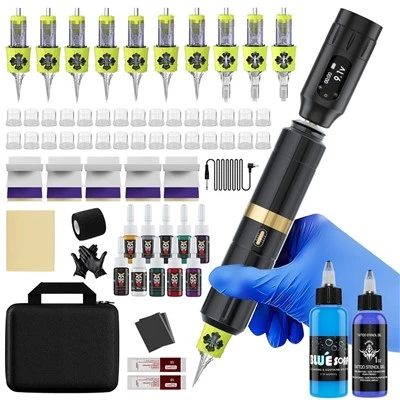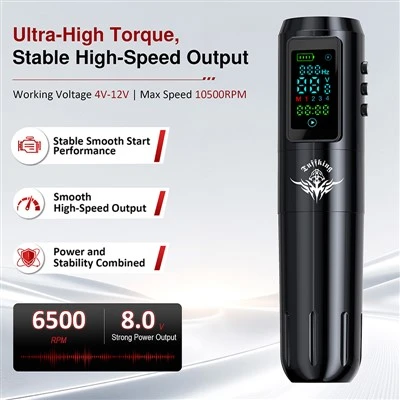
At present, the common tattoo machines on the market are mainly divided into two types: coil tattoo machines and motor tattoo machines. Only the coil type tattoo machine is introduced here. The following tattoo machines refer to the coil type tattoo machine.
When the tattoo industry just started, the tattoo machine was a big piece of equipment investment. No matter how trash the machine was, it cost thousands of dollars. This is not what it used to be. Machines with a few hundred dollars easy to use are everywhere. The price of the tattoo machine has dropped, but there are not many materials that specifically explain the structure of the tattoo machine. Here is a brief introduction to the tattoo machine, I hope it will be useful to everyone, and I hope my colleagues can correct me.
The tattoo machine is called a tattoo gun because it looks like a pistol. In fact, it is just a gorgeous name and there is no mystery. The structure and principle of the tattoo machine are extremely simple. In short, the principle of the tattoo machine is similar to that of a DC electric bell, except that the electric bell is struck with a small hammer to make a sound, and the tattoo machine uses a tattoo needle. Pierce the skin.
The structure of the tattoo machine and the names of its components have been marked in the figure above. The principle is as follows: friends who have studied physics in junior high school know that the electromagnet will attract ferromagnetic materials after being energized. This is easy to understand. After the machine is powered on, the current flows through the electromagnetic coil, frame, contact rod, shrapnel and other components to form a loop. The electromagnetic coil generates a suction force that attracts the armature to move down, which in turn causes the contact rod to contact the front shrapnel (ie When the contact) is disconnected, the current path is cut off, and the armature returns to the position driven by the rear shrapnel. The contact is closed again, and current flows through the solenoid coil, which attracts the armature to move downwards. In this way, the current is interrupted. Furthermore, when the coil suction is sometimes absent, the armature vibrates and drives the tattoo needle fixed on it to vibrate.
The debugging of the tattoo machine is more complicated than its working principle. The purpose of debugging is to obtain the right speed and the right strength. There are many factors that affect the speed and strength of the tattoo machine, and they affect each other.
The first is voltage. Increasing the power supply voltage can increase the speed and strength of the tattoo machine.
The second is the length and elasticity of the shrapnel. The harder shrapnel (that is, the more elastic shrapnel) and the shorter shrapnel can achieve higher speeds.
There is also the armature stroke (that is, the distance between the armature and the solenoid core). The greater the stroke, the slower the speed.
Then there is the contact strength between the touch rod and the front shrapnel. The greater the contact strength, the faster the tattoo machine. The contact strength can be changed by adjusting the degree of bending of the shrapnel. The inconvenience is that the adjustment of the contact strength and the mutual influence of the armature stroke require repeated adjustments.
In addition, the weight of the armature also affects the speed of the machine. The lighter the armature, the faster the machine speed.
The above briefly explained the structure principle of the tattoo machine and the factors that affect the speed of the machine. The debugging of the tattoo machine requires repeated trials in practice to be handy.